


Deployment 2010 to 2011:
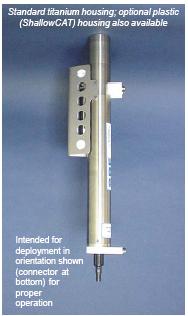
calibration info for SBE37 #2137
calibration info for SBE37 #2137
|
The calibration adjustments were based on the drift determined from the laboratory
calibrations at SeaBird before and after the deployment. The SeaBird sheets, while
very helpful, can be confusing at first sight (they have confused me in the past). Temperature: The plot below shows the lower portion of the SeaBird calibration sheet for the March 30, 2012 post-cruise calibration. The triangles close to the zero line represent the residuals from fitting bath temperatures to SBE37 output using the new (2012) calibration values. The circles indicate the residuals when using the same 2012 measurements, but converting the SBE37 raw frequency output to temperatures via the calibration coefficients determined back on Mar 31, 2009. In other words: without recalibrating the sensor (i.e., leaving it with the 2009 cal), in March of 2012 the SBE37 measured temperature too low. SeaBird determined the offset to be 0.27 mdeg C when averaged over the whole calibration range. For the temperature range we obeserved in the field between 0 and 10 ° C, it was essentially zero.   Conductivity: The conductivity correction followed a similar scheme. Again, the first plot below shows the figure portion of the SeaBird post-cruise calibration sheet. In this case, using the 2009 calibration coefficients showed residuals for the 2012 calibration measurements to be positive: i.e., the conductivity in the data file generated with the pre-cruise calibration was too high at the end of the deployment. In contrast to temperature, however, the correction itself was a linear funtion of conductivity ("slope correction").  We chose to use the 2009 cal to convert sensor frequencies into engineering data (conductivity), then linearly adjusted from zero slope correction at deployment time to full post-cruise calibration slope correction of 0.9995148 on recovery. The actual correction in terms of S/m subtracted from the original record (shown again in the lower panel of the plot below) varied roughly linearly from 0 to -0.0013 S/m over the time the sensor was in the ocean. It was of course close to zero at the very end when the sensor was back on deck but not yet turned off, as conductivity itself was zero then. 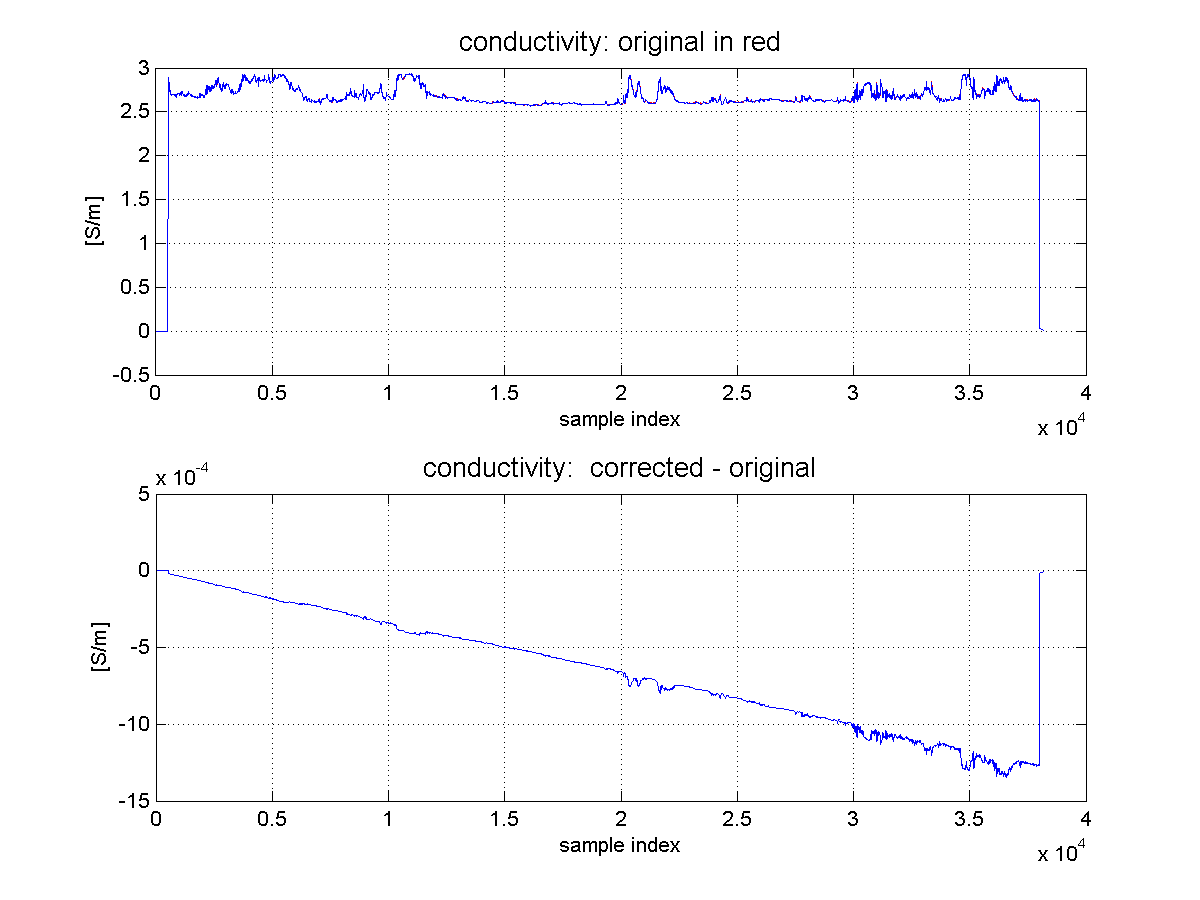 Pressure: The pressure sensor was not re-calibrated. However, other microcat pressure cals have shown the sensor to be very stable - in fact, I have not yet seen a pressure cal that resulted in a significant adjustment. |